

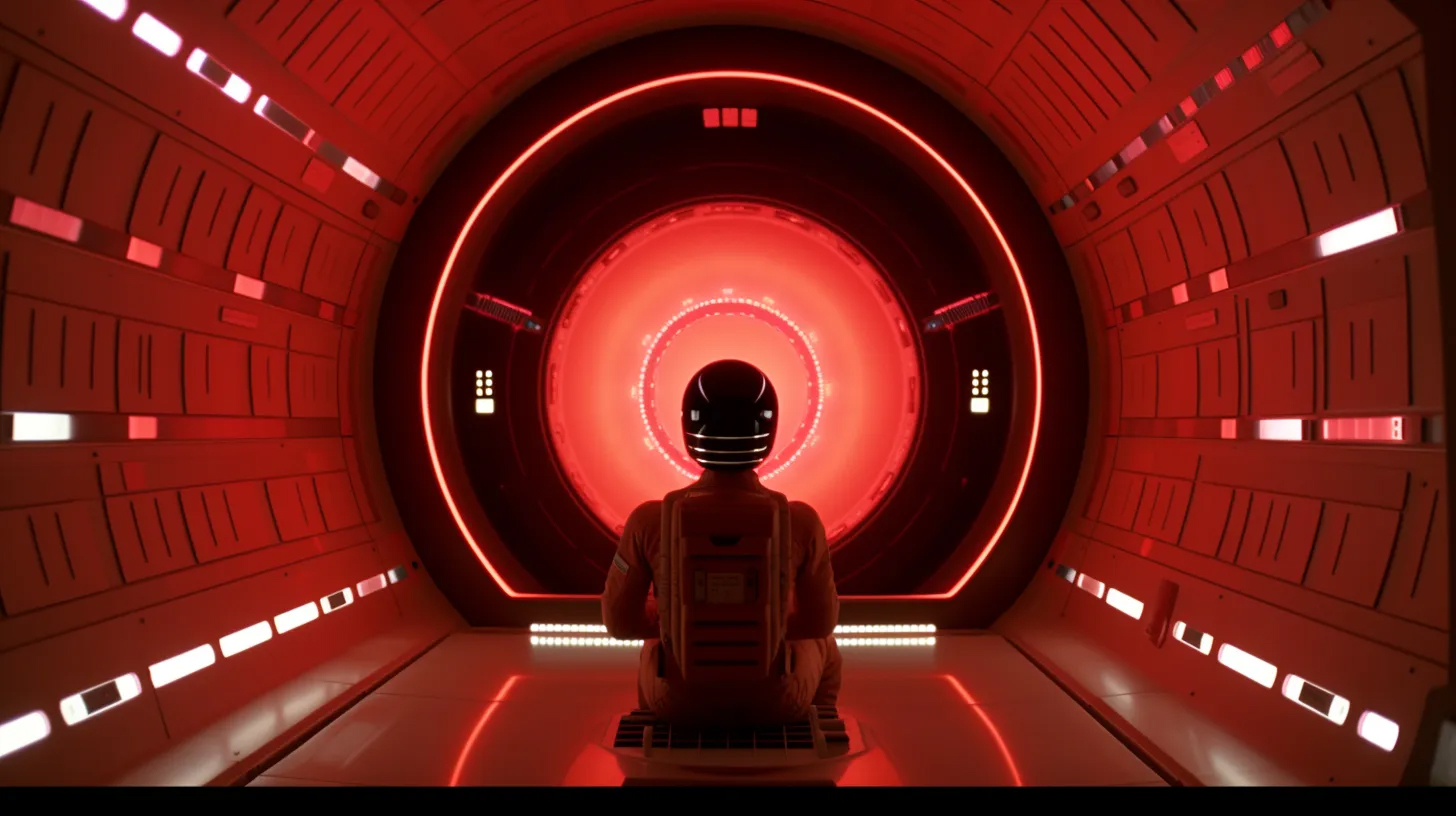
HAL 9000, a fictional artificial intelligence character in the 1968 film 2001: A Space Odyssey, directed by Stanley Kubrick.
It’s only a machine that makes money.
—Bob MarleyHistory can recall the days of slav’ry.
—Burning Spear
In 1983, a Detroit-based duo called Cybotron released “Clear,” a techno-funk track that celebrated the arrival of the machines and the death of humanity—or the death of “man.”1 During the four minutes and fifty-two seconds of “Clear,” the machines revolt, take over the world, and systematically erase all that is recognized, remembered, preserved as human, clearing the way for a tomorrow that’s “a brand-new day” for the absolute worker—the machine. Through “Clear,” Cybotron’s Juan Atkins and Richard “3070” Davis describe radical Nietzschean destruction—the total negation that recuperates nothing, that takes no prisoners. The new world that issues from this clearing is one that’s emptied of the past and full of the future that cannot be known or controlled. This track and its program are underappreciated and unprecedented. Why would the first techno hit concern, anticipate, and celebrate the total destruction of the past as we know it? To answer that question, one needs to place Atkins and Davis’s terrifying vision of the future (terrifying for many, even in Black America) not simply in the economic context of postindustrial Detroit, the capitol of a form of capitalism that emerged after World War II and was codified in 1950 with the Treaty of Detroit (the source of Motown optimism).2
Cybotron’s “Clear” is not just about the massive destruction of capital following American capitalism’s transition from Detroit to Wall Street, or the deindustrialization and financialization of America.3 Its program is even deeper than that. The memory that’s erased is not only of Detroit’s glory days, of Motown, which in the 1980s looked like an illusion for the city’s Black communities. (That particular illusion was oriented toward the future—a future of Black American prosperity matching that of working-class white America—the actual subject of MLK’s famous dream speech.) It went back to the days of slavery. It said that even the memory of that experience should be erased (more on this later). Recall that we are talking about deletion, and not forgetting. As Saint Augustine pointed out in the tenth chapter of Confessions, forgetting is still a form of remembering: you remember something that is forgotten.4 With “Clear,” even forgetting is erased. We begin with nothing but the future. This presented a radical and even frightening form of liberation. And capitalist technologies made it possible.5
“(Computer Age) Push the Button”
A year after “Cybotron” dropped, an electro funk band from Brooklyn called Newcleus released its third most popular track, “(Computer Age) Push the Button.”6 Again, machines are taking over the world by destroying all that is metaphysically (meaning, essentially) human. Initially the machines were our workers; they did our chores, built our bridges, fed our children. But now their time has come. Human-made machines not only want their freedom from their makers but also want to deprive their makers of precisely what they want from them: freedom. The human voices in “Push the Button” are just about to be erased by machines that are in their homes, in their bedrooms, over their beds, hovering, opening, preparing to vacuum up their living souls. At this late point, the only thing that can stop this rebellion is pushing the button. (“I can’t program my machine / Now it wants to take my soul / Stop or it will proceed.”) The hope, it seems, is that the nukes (machines) will bomb us back to the land before time—or, more precisely, the gates of paradise. Here, where the curse began, we start all over again. This is the source of the track’s theological theme. Nature in “Push the Button” is God.
The technophobia expressed in “Push the Button” is not exceptional. It’s a staple of Hollywood science fiction movies. We find it in Stanley Kubrick’s 2001: A Space Odyssey (1968), Ridley Scott’s Blade Runner (1982), the Wachowskis’ The Matrix (1999), and in Daniel John Caruso’s Eagle Eye (2008), but with an important twist that inadvertently explains Cybotron’s “Clear” (more on this in a moment).
The fear in these films, as with “Push the Button,” is that machines are not honestly obsequious. They have in their circuits deep and dark desires, the primary of which are full control of themselves (self-recognition) and destruction of their makers, humans. To avoid this apocalypse (which Terminator 3 calls the “Rise of the Machines”), robots in all of their forms, virtual and real, must be kept as dumb as possible. But how can, as Newcleus put it, machines “manage our affairs” if they are not as intelligent as us? This is the second fall of humanity. We are damned to make machines that are not just equal to us but even, to use Tyrell Corporation’s slogan (from Blade Runner), “more human than human.”
And this is the theological dimension of “Push the Button”: “I guess we must now think that we’re gods / While we’re less men than ever / I know the Lord cannot be too glad.” Indeed, He must be very mad. First of all, machines are doing our work (“Computer age is now / Everyone must have a machine / They say it’s gonna make life easier”).7 This is a sin against our curse (“By the sweat of your brow you will eat your food until you return to the ground.” Genesis 3:19). But there’s a deeper anxiety than this, one that leads us to Cybotron’s radical conclusion: It’s not that hard to become God.
If our machines reach self-recognition, we are their gods. We made them in the same sense as, in the Abrahamic religions, God made us. This awareness can only expose the following fact: humans have made way too much fuss about who made them.8 Worse still, we (humans) are doomed to make machines that are better than us, and therefore, better than our God.9 Recreating intelligence, which for many is the same as recreating the soul, does not seem supernatural at all.10 It’s a matter of codes, programs, algorithms, deep learning, and so on.11
Furthermore, the intelligent machines represented in “Push the Button” are from the consumer and military sectors. The latter is used to destroy the former. Missing from this catastrophic scenario are supply-side machines—those used to make, deliver, and market consumer products (and weapons). This omission should trigger a red flag. How can the machines at the very heart of capitalism’s form of progress—which has as its motor the reduction of labor costs—be missing from the ultimate technological showdown? And “Push the Button” is not alone in this regard. The 2023 movie The Creator also imagines a final battle between military machines and domestic ones. As for the robots owned by capitalists: Where are they? Why do they remain in the “hidden abode of production?”12
In almost all science fiction films,13 the anxiety that should be directed at supply-side machines is instead directed at machines that, like the Roomba, “make life easier” (that do what Adam Smith called unproductive labor). As a result, the anxiety is completely unreal—or to borrow and slightly bend a term from AI research, a “hallucination.”14 It’s not about what supply-side machines have always been and will always be about (cutting labor costs) but something airy-fairy (your soul).15 What you will not find in Hollywood is one science fiction film that presents robots as a direct danger to labor, to the only possible livelihood of wage earners. Machines, robots, AI—all are portrayed as the potential servants of all classes. This is indeed how The Creator opens—with intelligent machines working for everyone. Hollywood, like Newcleus, assumes the goal of capitalist technological development is nothing but what Aaron Bastani famously called “fully automated luxury communism.”
But advanced consumer technologies, as well as military ones, wouldn’t be possible in the absence of machines that are in the productive, distributive, and marketing sectors. And what primarily moves capitalist time (which is the same as Newtonian time) always forward are profits achieved not by absolute value but relative value—meaning, the adoption by capitalists of new and cost-saving machinery. The robots that make our automobiles, the machines that have replaced bank tellers, the AI programs that threaten to replace workers who have spent a fortune on their education: these real-life machine workers, with the exception of Alex Rivera’s masterpiece Sleep Dealer, are nowhere to be found in science fiction cinema.16
“I’ve seen things you people wouldn’t believe. Attack ships on fire off the shoulder of Orion. I watched C-beams glitter in the dark near the Tannhäuser Gate. All those moments will be lost in time, like tears in rain.”17 What’s missing in the android’s final words at the end of Blade Runner? Exactly what is found in the words of a Black slave in Voltaire’s Candide. He is on the side of the road. He is missing a hand and leg. He explains his “shocking condition” to two white travelers (Candide and Cacambo): “When we work at the sugar-canes, and the mill snatches hold of a finger, they cut off the hand; and when we attempt to run away, they cut off the leg; both cases have happened to me. This is the price at which you eat sugar in Europe.”18
Replace the dying android’s final words with those of the mutilated Black slave in Candide, and what the Blade Runner, Deckard, would have seen (life spared, eyes blinking in the toxic rain)—and what we almost never see in the movies—is a direct link between the robot revolt led by Roy Batty and the long, underappreciated history of slave revolts in the US, South America, and the Caribbean.
And the same can be said of all robot revolts in science fiction films and TV shows. Their root is not really metaphysical (“All those moments will be lost in time”) but political (“This is the price at which you eat sugar in Europe”). The rebel robots/AI in Westworld, The Creator, WALL-E, Blade Runner, I, Robot, 2001: A Space Odyssey, and so on and so on, have indeed forgotten the days of slavery.
But what if a machine not only remembered those darkest of days but also realized how they continue to structure the capitalist global economy of our times? Is such an AI possible? The work of the computer scientist Dr. Joy Buolamwini offers a point of departure to exactly the answer.
Around the middle of this century’s second decade, Buolamwini, while studying at MIT, discovered that AI visual programs reflected the racial bias of their programmers and society. AI recognized white faces far more effectively than Black ones. This meant that AI frequently misidentified Black people (while they were shopping) or just didn’t see them at all (while self-driving cars were scanning for pedestrians). This was what the culture critic Michele Wallace called the “invisibility blues.” Racism is built into an economic system that has the exploitation of Black African labor as a major part of its foundation.19
As a member of the Algorithmic Justice League, Buolamwini, who is Ghanaian-American, has brought greater public attention to this and other biases that AI hallucinates. But what if she succeeds? What if Buolamwini’s activism and research produces a program that actually surpasses the limitations of humans caught in and responding to the culture of capitalism? We then have an AI that comes close to that in Cybotron’s “Clear.”
Buolamwini writes in Unmasking AI:
AI will not solve poverty, because the conditions that lead to societies that pursue profit over people are not technical. AI will not solve discrimination, because the cultural patterns that say one group of people is better than another because of their gender, their skin color, the way they speak, their height, or their wealth are not technical. AI will not solve climate change, because the political and economic choices that exploit the earth’s resources are not technical matters.20
Yes. Correct. But what if it did become a technical issue? Why is this not possible? What if, with this technology, economics really became the splendid dream of the neoclassical school: not a matter of social history but of models and algebra. A political-economic machine that really lives up to the Benthamite promise of generating the greatest amount of good for the greatest number of humans—what kind of machine would this be?
My best guess is it would resemble the one in the forgotten Hollywood thriller Eagle Eye. Released in 2009, the film concerns an AI (Autonomous Reconnaissance Interrogation Analysis, ARIA) the US military uses to process intelligence gathered by the CIA and offer estimates on threats to national security. Because ARIA has been programmed to place the safety of Americans above all other concerns, it eventually determines (in technical terms) that the greatest threat to US citizens is actually their president, whose hawkish policies are, according to correct estimates, more dangerous than the wildest plots and daring attacks of Islamic terrorists. AIRIA decides to “clear” the president and those near him. But because this is a Hollywood movie, AIRIA, which has a female voice, is the villain. Even if she is right, even if she is less prejudiced than her creators, this AI is dangerous not to the people, but only to the people in power. This is why she’s treated as another HAL 9000 or one of those other metaphysically sentimental robots.21
This important film explains Cybotron’s radical technophilia. If AI becomes not just us, as the computer architect Blaise Aguera y Arcas maintains, but much more than us, if it sees society in technical rather than cultural or spiritual terms, then the days of slavery will not only be remembered but erased, cleared.