

A new way to explore
contemporary art and ideas
Glitch as a political language
Errors, distortions, and technological failures become tools to reveal hidden systems and disrupt dominant narratives.
[ e-flux ]
[ e-flux ]
That Singing Crowd
Collective screaming is framed as a symptom of political and linguistic breakdown—an affective overflow where public discourse collapses into noise—while Bennani’s edited choir becomes an allegory for a nation “conducted” into conformity yet unable to communicate across mediated divides.
Through the aesthetics of the glitch and Flusser’s “stutter,” the work critiques platform-conditioned perception and proposes looped interruption (akin to wavetable synthesis) as a hybrid human–machine mode of resynthesizing voice when progress, clarity, and agency are captured by algorithmic systems.
Read more

[ e-flux ]
[ KADIST ]
[ KADIST ]
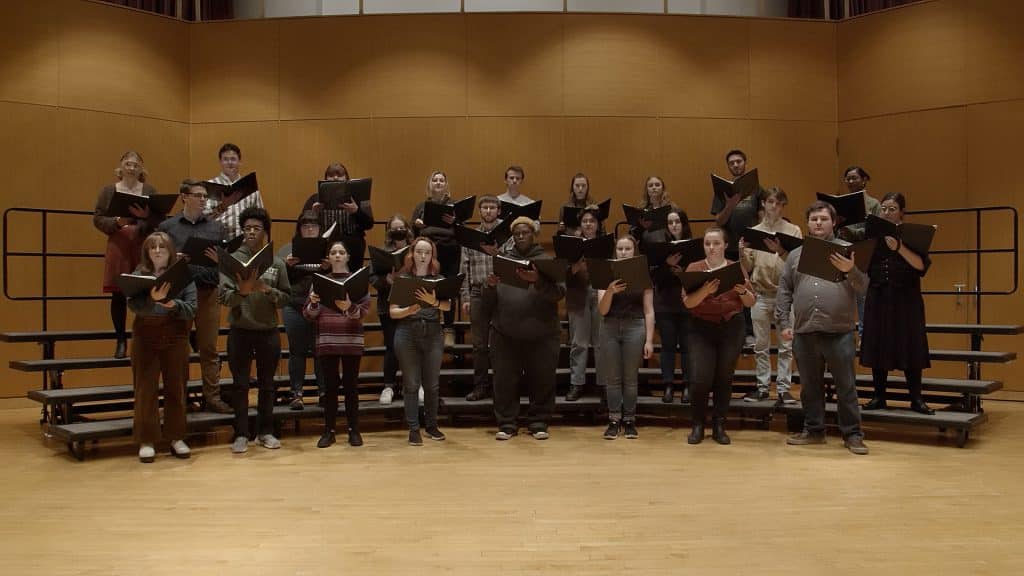
Five-Hundred Twenty-Four
A digitally composited chorus counting to 524 mobilizes singing and enumeration as elemental social technologies, turning the score into a roll call that measures community from within while staging a temporary collective assembled from dispersed, pre-existing groups. By juxtaposing choirs across distinct local contexts, the work operates as a participatory sociological portrait and a post-pandemic meditation on mediated togetherness, social fragmentation, and cyclical thresholds of life, death, and renewal.
Read more
[ KADIST ]
[ KADIST ]
[ KADIST ]
Datamosh
Glitch aesthetics and datamoshing are mobilized as both medium and critique, parodying rap-video spectacle while foregrounding digital malfunction as a self-reflexive strategy that exposes the constructedness of online images. Rooted in post-internet and millennial vernaculars, the practice collapses music, social media, and contemporary video-art lineages into a commentary on fame, iconography, and the circulation of cultural “energy” through networked symbols (from pop-ups to emojis).
Read more

[ KADIST ]
[ e-flux ]
[ e-flux ]
Images Are Masks
Images operate as masks within an algorithmic propaganda ecology where context is stripped, truth is manufactured through virality, and the state’s visual regime merges nationalism, surveillance, and censorship to rewrite history while punishing dissent. Against the collapse of verification and the commodification of journalism, the text proposes glitch, opacity, and coded metaphor as aesthetic-political tactics that reintroduce doubt, expose the constructedness of “truth,” and contest the weaponization of representation.
Read more

[ e-flux ]
Back to top