
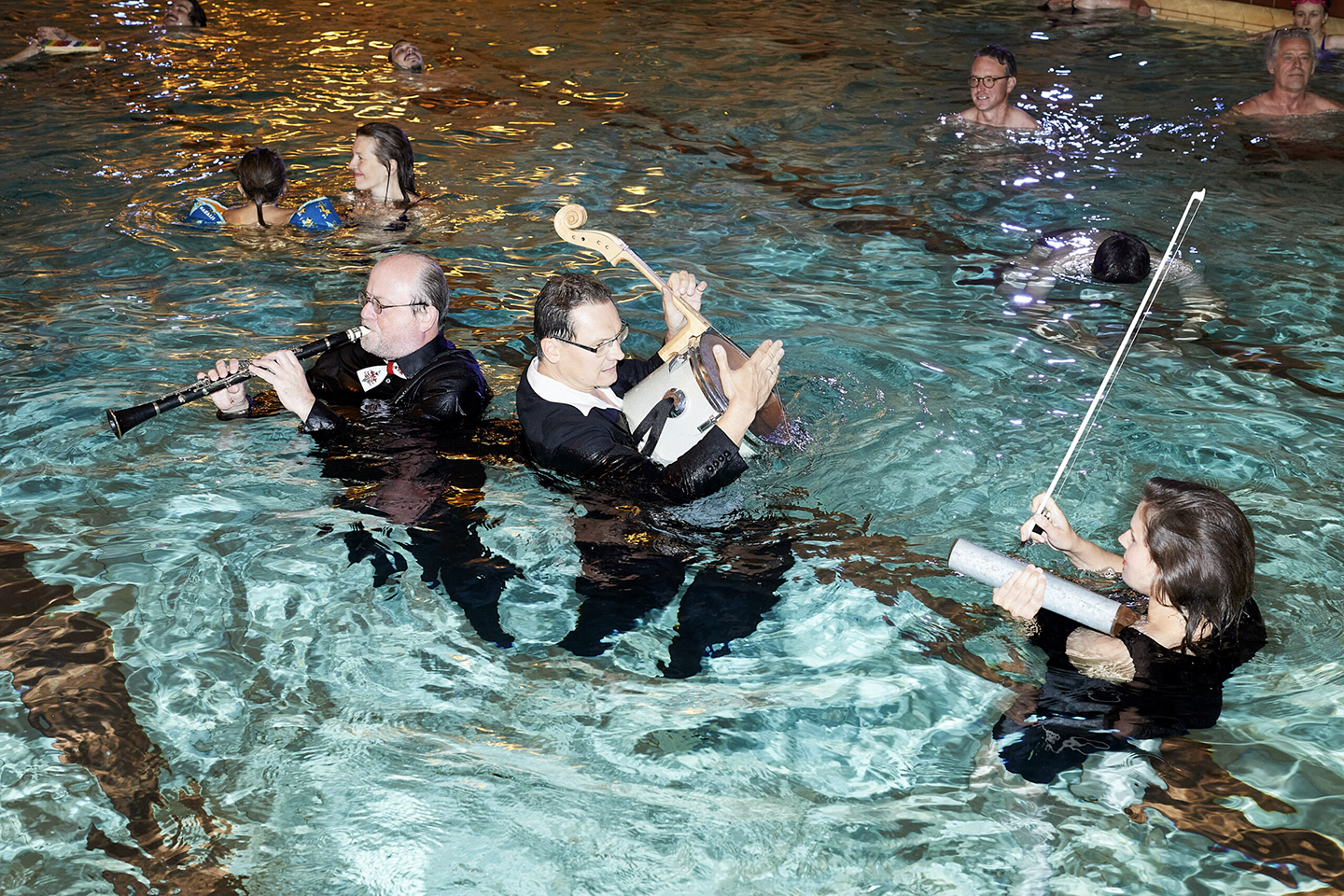
Water Music 1970, Ensemble Comp. (Milan Adamčiak, Robert Cyprich, Jozef Revallo), in a new interpretation by Trio Romanovská Tichý Hrubý, Prague, 2022.
For the past thirty years I have engaged consistently with music-making through three different roles, each with their own distinct social character: rock drummer, improviser, and composer. While the first two are largely collaborative experiences, where the various ensemble members have a more or less equivalent role in the creation of music, composing scores is a solitary practice. Yet it still necessarily involves other people if you want to write for someone other than yourself and hear your work. In some cases, a composer locks herself away to create a written score that the musicians rarely see until it’s completely finished, an approach akin to a painter or a novelist, where the creative practice is rarely shared outside the primary artist. However, there is an expectation in “new music”—an outgrowth of eighteenth- and nineteenth-century classical music—that once a score is handed off to the performers, some transformation, more often called “interpretation,” will take place. I do believe that the written document and its resultant music necessarily and inherently change once in the hands of someone other than the composer. The composer and performers need each other (just as improvisers and rock bands need each another), but in such a way that the composer has a higher position of power in the social hierarchy of contemporary music. Practitioners of free improvisation and politically minded composers, such as John Cage, Earle Brown, and Christian Wolff, who sought to dismantle this lopsided distribution of power, often cite this dynamic as a criticism of composed music. And yet it is still these composers’ names—the authors but not performers of their music—that are written in the history books. Is this fair? Are these composers having their cake and eating it too by removing themselves as leaders in the creative process yet still being cited as the primary artist of their work?
For this issue of e-flux journal, I have been asked to write about composer-performer labor relations in the context of the written musical score. I believe I’ve been asked to do this based on an assumption that there is an unjust hierarchy between composer and performer, in which the composer has disproportionate power, given that she is essentially asking performers to do her bidding. If you ask a hundred musicians their thoughts on this topic, you will likely get a hundred different answers. I am only comfortable speaking from my own experience as a composer who has been careful but very open about where and how I present work. While I am certainly aware of composers taking advantage of or mistreating their performers in the name of their art (for instance, I have terrible memories of being screamed at repeatedly in rehearsals by a famous composer whose work I played in college and who I had admired before I met him), over the past twenty years I have positioned myself as a professional composer in such a way that I’m generally working with people who are excited to do the things I ask of them, and thus I have largely had only positive experiences. The people who ask me for music are often already my friends, or at the very least friendly acquaintances, and they are almost never so far outside my social sphere that they would be surprised, much less feel abused, by the power I wield as the person who writes the document that tells them what to do. Ultimately, I’m a score-making musician because it’s the way I’m able to compose music that’s more complex and varied than writing solo percussion pieces for myself. For many years, composing has been the most appropriate and exciting way for me to create music.
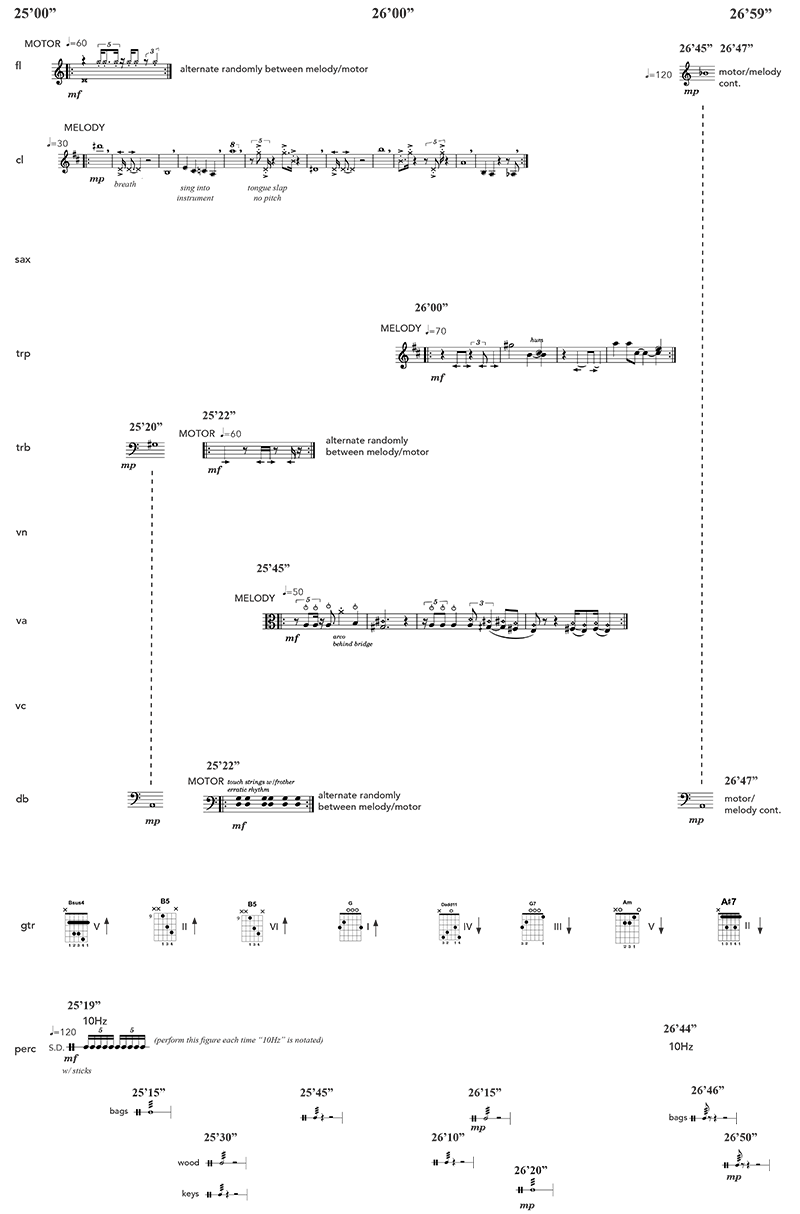
Sarah Hennies, Motor Tapes, for 12 musicians, 2022.
My entry into experimental music was as a teenager in the early 1990s, through playing in indie rock bands and shopping at record stores that dealt in what could reasonably be called “underground DIY music”—music that was unaffiliated with academia, arts grants, or other institutional approval. But when I was sixteen years old, amid my deep love for San Diego and DC post-hardcore, and still in my early years of learning “serious” percussion playing, I encountered music by John Cage, Harry Partch, George Crumb, and Iannis Xenakis. For reasons I can’t totally explain, I became obsessed. Somehow at such a young age I knew that this was what I wanted to do, although it would take six years as a university percussion student and over twenty years of rock bands and experimental improvisation before the written score would become the primary focus of my musical life. The creation of my percussion solos Psalms in 2009 set me on the path I continue walking today. These three solo pieces (for vibraphone, snare drum, and woodblock, respectively) came about through performing Alvin Lucier’s Silver Streetcar for the Orchestra for triangle a year earlier, and realizing that I had made an almost identical work for vibraphone as a student several years before, long before I was aware of Lucier’s piece. My resulting pieces consist of simple, repetitive pulsing on a single instrument, where changes in striking position, dampening, and other parameters result in thrilling acoustic phenomena and hypnotic repetitions that are still at the core of the work I do today. Ironically, the Psalms did not have written scores until seven years after their creation, when other people started asking me to play them.
Improvisation has been an important part of my artistic practice since I was a teenager; it is something I have always done and will continue to do. But in my early thirties I began to move away from this music and more towards composed music that felt closer to my goals and identity as a musician. Herbert Brün once said that in improvisation, one’s first idea is almost always the best one, and in composition it is almost always the worst. What has always appealed to me about scored music is the ability to craft something before it happens, making it into exactly what I want to hear and minimizing the risk of unwanted outcomes. Much ado is made in improvisational music circles about the lack of traditional hierarchies and power structures in so-called free music, and while I have no interest in pitting improvisation and composition against each other, by 2009 I had grown weary of the predictability and pitfalls of this type of music-making. I found that concerts I attended (and performed) that purported to be spontaneous music had become quite rote and predictable, with most improvisers relying on a honed and refined collection of sounds and techniques employed with a more or less consistent musical approach, regardless of the performance situation or grouping of musicians. Brün called improvisation “a spontaneous use of an already-learned language,” and it was and continues to be my desire as an artist to make things happen that I haven’t heard before—that I feel could not occur spontaneously.
My trio Meridian, formed in 2012 with Tim Feeney and Greg Stuart, developed a highly refined approach to improvising that was very exciting because of our musical and personal kinship with each other. A commitment to playing together led to many things I hadn’t previously thought possible in improvised music. That said, after a couple years together Greg rightly recognized that we had honed our approach to improvisation so much that we were essentially performing the same piece every time we played together —the same problem I’d had with improvisation in the first place. Although the sounds and order of events changed, the overall arc, approach, and effect of the performances were remarkably consistent in what was ostensibly spontaneous music. I was also bothered by my lack of control and the potential for undesirable outcomes. Every musician has certainly experienced failures in performance but I found that the type of improvised music I was doing was especially prone to this; some nights things would just simply not come together, despite the various participants all sharing a similar musical vision.
In 2011, during the No Idea Festival (Chris Cogburn’s wonderful annual event) in Austin, I overheard two musician friends talking about a tour they recently completed. They said that some shows had gone great and others had gone terribly. In that moment I thought to myself, why would I make music that I might not like, and furthermore, why would I do it in front of an audience? I loved the social aspect of rock bands and improvising, but ultimately found myself artistically frustrated by their limitations. By making decisions in advance—composing a score—I found that I could create music that I truly had not heard before, and I could have a highly satisfying level of control over the resultant performance, while still allowing space for things to occur that I could not have made happen with notation alone. For me, writing down your instructions is, of course, a practical tool for getting other people to play your music, but more profoundly it can make something happen that could not exist without the score.
In January 2021, for a period of several days I inadvertently became the main character (that is, villain) among the new music composer/performer community on Twitter. It was the height of the Covid-19 pandemic, I was driving eight hours a week for my teaching job, and I was in the midst of a serious years-long mental health crisis. Perhaps these were not the ideal circumstances to be judging a composition contest but alas, that is what I was doing. I was in a motel in Troy, New York one night on a break from working on a friend’s art piece, trying to get through hundreds of scores submitted for an open call that I’d been invited to judge by some friends in Atlanta. The majority of scores were indistinguishable from each other and I began to notice that many of them shared a similar trait: “poetic” performance instructions more akin to what you’d tell an actor for their emotional motivation in a play or film. These type of instructions are an outgrowth of classical music from the nineteenth-century, when composers branched out from traditional markings such as “allegro,” “largo,” “cantabile,” etc., to use more descriptive language. For example, the opening of Debussy’s “Clair de Lune” is marked as “Andante très expressif,” expanding on the classical method of indicating tempo without a specific number for beats per minute. These notations have since developed into something far removed from their origin. Today it’s not surprising to see “Like the first ray of sunshine on a spring morning” written over a simple melody or even a single whole note. It was admittedly naive of me to post on Twitter to “advise” the public on what I see as unplayable, unhearable notational devices, and certainly ill-advised to do this while experiencing a mild hypomanic episode, but nevertheless I impulsively took to social media to campaign for the end of such performance instructions. My complaint was that if they can’t be played or heard, why write them at all? I quickly found myself on the receiving end of dozens of angry and often outright mean responses. While these were amusing at first, I finally had to delete my post when I woke up on day three of this barrage to a direct message that said, “I feel sorry for your students.” I had touched a nerve.
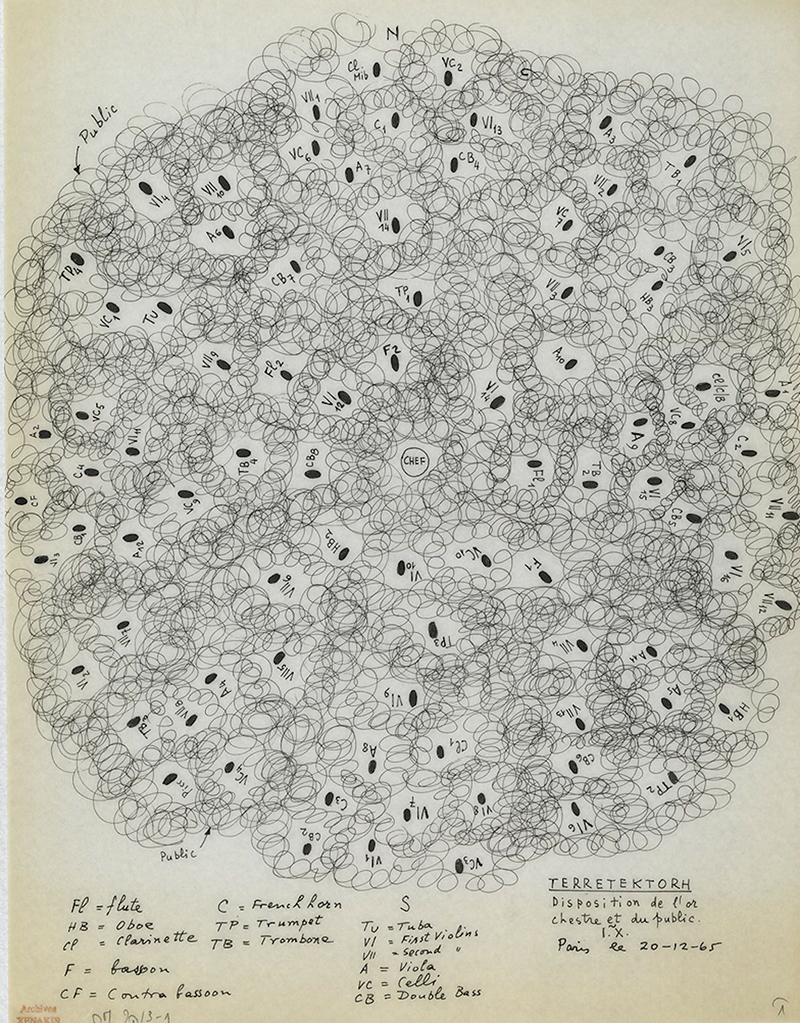
Iannis Xenakis, Terretektorh, Distribution of Musicians, 1965. Courtesy of the Iannis Xenakis Archives, Bibliothèque nationale de France.
It’s not my wish to restart this pointless debate (people can make scores however they want and it’s really none of my business), but I believe my hatred of these kinds of instructions stems from my time as a university percussionist. For two years in the early 2000s I was a graduate student at University of California San Diego. I went there because I wanted to study with percussionist Steve Schick, but even more, I wanted to be around people who were making contemporary music, as I had previously been at a fairly traditional music program at the University of Illinois. When I got to San Diego, I was shocked that the majority of my time was not spent playing Xenakis but performing dozens of grad-student compositions every year. I was essentially an indentured servant of the new music academy whose forty to fifty composers relied on a comically small number of performers to play their work. It’s in this contemporary music assembly line—forced to relentlessly perform music you don’t want to play for a meager sub-living wage in the form of a graduate assistantship—that you quickly learn to despise composers who cannot clearly and succinctly tell you what they want. But so much contemporary chamber music relies on this labor.
Surprisingly, many of my angry Twitter respondents cited the same justification for writing poetic performance instructions: “I want my performers to know that I respect them.” The implication is that the composer shows trust in performers by allowing them to “interpret” the score. The underlying assumption is that writing ambiguous instructions gives the performer more freedom than clear instructions. As a composer who mostly works with friends or at least friendly people, this notion makes me wonder: What performers are these people working with and why do they feel so disrespected? Why do composers feel the need to prove that they welcome and value the artistic choices of people playing their music—when performers making their own interpretive choices has been integral to the composer-performer relationship for hundreds of years? The answer, of course, is that performers often come from places where they are not valued and respected: music schools and symphonies. There is a pervasive and often valorized abuse of power (the famous “great man” composer screaming at a college student to play his music correctly) that runs through the places one learns to perform scored music. At best, this may inspire students and professionals to a high level of achievement (but at what cost?). At worst, it results in heinous abuses of power. Orchestral/classical music is overwhelmingly male-dominated, with female conductors and section leaders as an extreme minority. This disparity has led to rampant discrimination, sexual harassment, and abuse. There have been high-profile scandals at Juilliard, the New York Philharmonic, and multiple other symphony orchestras and music programs, where men are the kings of the castle. Numerous accounts of this unfair treatment have been bravely chronicled, notably on the Substack and Facebook page of oboist Katherine Needleman.
I’m a self-taught composer and I’m always careful not to call what I do “classical music.” While I may teach at a college (albeit one that is highly nontraditional) and have received grants and awards from prestigious institutions, my identity still lies with my DIY roots. My music grows from this sensibility rather than one learned at music school. To me, examining the hierarchy between composer and performer illuminates how important the social aspects of my practice are to the music I make. Many of my best pieces have arisen from the friendships I have with the performers; I place immense trust in them to realize my music, which comes from a deeply personal and often painful place. In an ideal composer-performer relationship, you make each other better. For me, it is most exciting when Bearthoven, Bent Duo, Tim Feeney, Judith Hamann, Tristan Kasten-Krause, Steve Schick, Greg Stuart, richard valitutto, Nate Wooley, and so many others whom I’ve had the great privilege to work with bring my music somewhere beyond what I thought was possible. A performer is always going to transform the written score, even if only in small ways, but some of my most valuable experiences as a composer have been when a performer sees something in the work that I do not, bringing their own taste, experience, judgment, and ideas into its realization. The score and the social relationship between composer and performer are inseparable. In the best possible scenario they are in a beautiful, mutually elevating symbiosis.
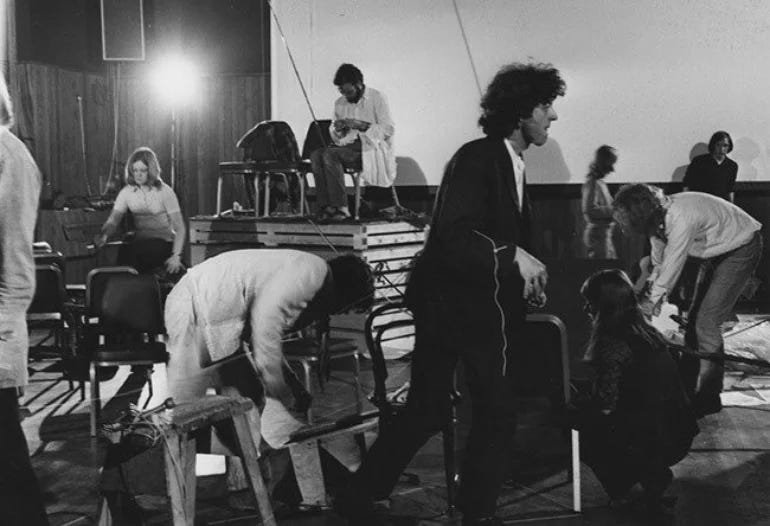
Cornelius Cardew with the Scratch Orchestra.
Cornelius Cardew’s eight-hour magnum opus The Great Learning (1968–70), written for “trained and untrained musicians,” is a radical work with many compositional innovations. But perhaps even more important is the great feat of organization that must take place to realize the piece. Written in seven movements called “paragraphs” (each based on a different portion of a text by Confucius), the work calls for dozens of performers to follow Cardew’s often hyper-precise instructions. The score includes a great deal of vocalizing, pipe organ, drums, bass instruments, and many other elements, resulting in a work that often feels like a mass political protest staged as experimental music. Having been involved in multiple performances of the work, I’ve learned that the greatest challenge of Cardew’s masterpiece is the seemingly mundane task of organizing rehearsals. Because the piece needs at minimum fifty performers (but more is always better), when you start to schedule things you realize quickly that all of those people have jobs to do, classes to attend, and children to take care of. To participate, you must decide that The Great Learning is something you need in your life, that the benefit of doing this piece is greater than tending to other everyday responsibilities, and that the end result provides a benefit (aesthetic, social, emotional, psychological) that you cannot access in any other part of your life. This, perhaps, is the utopian ideal that drew me to composed music as a lonely, sad teenager: one can find friendship, intimacy, and togetherness around the common goal of performing strange and exhilarating music. The major details of my life—that I’m a queer, transgender, bipolar parent working as an experimental musician—mean that I can relate to almost no one. But through composition I can engage and nourish the most personal aspects of myself directly with other people, and others can project their own experiences onto the resulting music, creating an artistic experience that is not “about me” but for everyone.
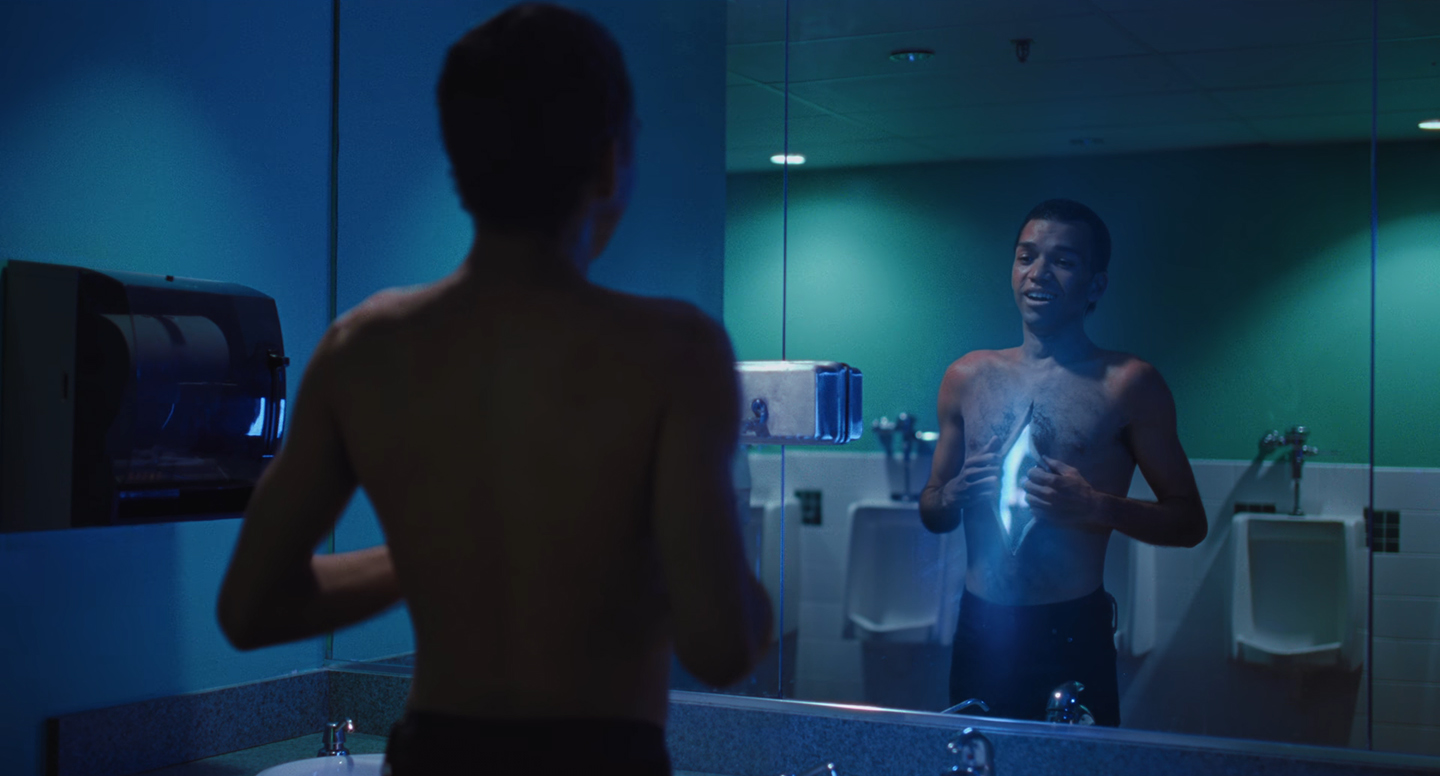
Jane Schoenbrun, I Saw the TV Glow, 2024, film still.
At the premiere of my 2021 piece Clock Dies, during a particularly frantic section in which multiple overlapping loops and tempi gradually coincide into a cathartic climax, I began to laugh in disbelief. I leaned over to my partner Mara and whispered, “I feel like I’m inside my own head!” We are often looking for ourselves in the work of others. Often a strong emotional response to someone else’s music reflects as much on the listener as it does on the composer. But I almost never “see myself” in other people’s work in the same profound way I do in my own, and thus I must do this work myself. Last year I watched Jane Schoenbrun’s film I Saw the TV Glow, and for the first time in my life I saw an experience related to my gender (one that almost all trans women have) reflected back at me in a piece of culture. This caught me so off-guard that I began to cry, both due to the shock of seeing this very powerful, private, and taboo experience on screen, and due to the therapeutic release of loneliness and tension that I didn’t realize I was carrying. These moments are exceedingly rare for me to experience in other people’s work, which is part of my drive to write my own music. It’s through crafting a written score that these moments of validation, recognition, and liberation can take place. By making a score, the composer can open a window that welcomes others into your house while also allowing you to climb out and leave for a little while.